***
History of Booksellers and Stationers in British Columbia
***
Before I continue the story of the British Columbia Stationery and Printing Company and John Bowerman Ferguson, let’s meet the other bookselling partner in the venture: Thomas Robson Pearson.
Born in 1858 in Oshawa, Ontario, Pearson came to Victoria in 1877, and then to New Westminster in 1879 (1).
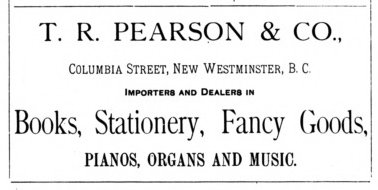
Soon after settling in New West, Pearson entered the book and stationery trade, establishing T.R. Pearson & Co. on Columbia Street.
Pearson’s middle name, Robson, came from his mother Isabella’s family. Isabella Robson Pearson was the sister of John, David, and Rev. Ebenezer Robson, all of whom were actively involved in the development of BC in the province’s early days.
John Robson, of course, was premier of British Columbia from 1889 to 1892. But before becoming a politician, John was a journalist, serving as editor of the original British Columbian newspaper in New Westminster in the early 1860s, and then as publisher of the new British Columbian from 1882 to 1883. David Robson was also involved in the reincarnation of the newspaper, and when John left to pursue his political career in Victoria in 1883, David took over management of the paper (2).
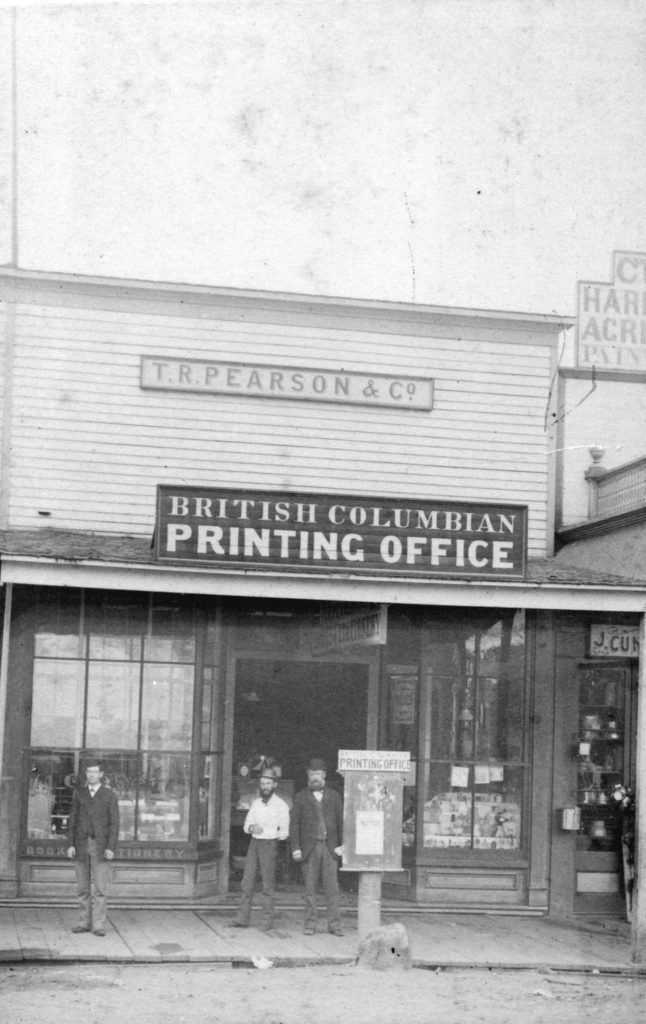
It is unclear whether Pearson and his uncles were partners in T.R. Pearson & Co. and/or the British Columbian (a February 1883 notice in American Stationer suggests that Pearson and John Robson might have been partners in the book and stationery company [3]), but the two enterprises shared the same premises, as seen in this photo from the City of Vancouver Archives (4):
By January 1886, T.R. Pearson & Co. had expanded to Vancouver (actually still called Granville at the time) (5), and then in May, Pearson folded his New Westminster and Vancouver stores into the newly formed British Columbia Stationery and Printing Company. David Robson also partnered in the venture, bringing in his British Columbian Printing Company. And J.B. Ferguson brought in his book and stationery firm in Victoria.
As I’ll cover in my next post, the BC Stationery and Printing Company turned out to be relatively shortlived. So was the remainder of Thomas Robson Pearson’s bookselling career.
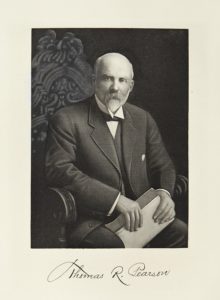
In 1887, Pearson married Edith Eleanor Major, daughter of C.G. Major (who was brother-in-law to George Clarkson, a New Westminster bookseller in the late 1860s—I’m telling you, the connections between these early booksellers form an intricate web!).
Also in 1887, Pearson withdrew from the BC Stationery and Printing Company, sold his New Westminster bookstore to David Lyal (6), and entered a partnership with his new father-in-law. Operating as Major & Pearson, the firm dealt mainly in real estate and insurance. When the Dominion Trust Company was established in 1906, Major & Pearson was incorporated into it, and Pearson became a director and manager of the new company (7).
Pearson was widely esteemed in New Westminster business and social circles, and he and Edith had three children. He died in 1947 at the age of eighty-nine (8).
Notes
(1) Biographical information about Pearson is mainly from British Columbia Pictorial and Biographical, vol. I (Winnipeg, Vancouver, and Montreal: S.J. Clarke Publishing Co., 1914), 289–295.
(2) From description of the Columbian Company Fonds at the New Westminster Archives.
(3) American Stationer (February 22, 1883): 263.
(4) The City of Vancouver Archives dates the photo as 189_, but I believe this is an error, as T.R. Pearson & Co. was no longer in operation after 1887.
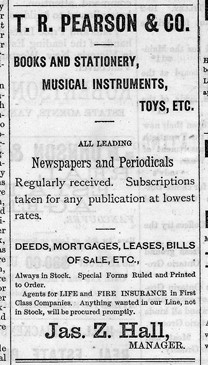
(5) Ads in the British Columbian for T.R. Pearson & Co. starting in January 1886 show “New Westminster and Granville” as the company’s locations.
(6) “Announcement: Change of Business,” Daily British Columbian (March 1, 1887): 2.
(7) British Columbia Pictorial and Biographical, vol. I., 293-294.
(8) “T.R. Robson of Royal City Dies at 89,” The Province (November 24, 1947): 2.
***
I was in Winnipeg (my hometown) for a few weeks this summer, and that got me thinking about a BC bookseller with a Winnipeg connection: John Bowerman Ferguson.
Part of the BC bookselling scene from 1885 to 1889 in Victoria and Vancouver, Ferguson was originally from Ontario. But before establishing himself in BC, he spent close to a decade in Winnipeg, initially as a school teacher and then principal at the Central School from 1876 to 1882 (1), and then as a partner in Parsons & Ferguson.
Building on the wholesale stationery business started by Silas R. Parsons in 1878, Parsons & Ferguson not only dealt in stationery, but also acted as agents for the sale of mining stocks, farms, and other property.
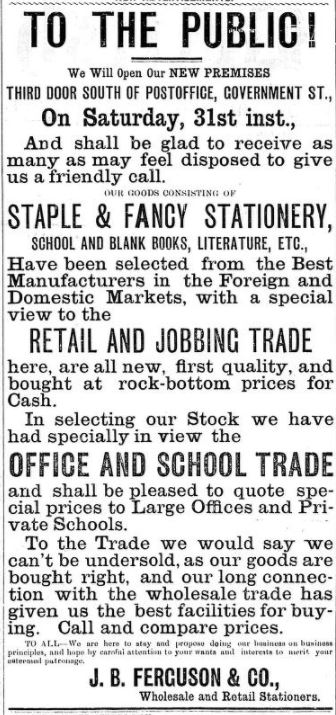
In March 1884, Ferguson’s intention to move to Victoria was announced in the British Colonist. Calling Ferguson “a leading stationer of Winnipeg,” the Colonist noted that he had leased the building formerly known as the Brunswick on Government Street and would soon be opening a “first-class stationery and fancy goods establishment” (2).
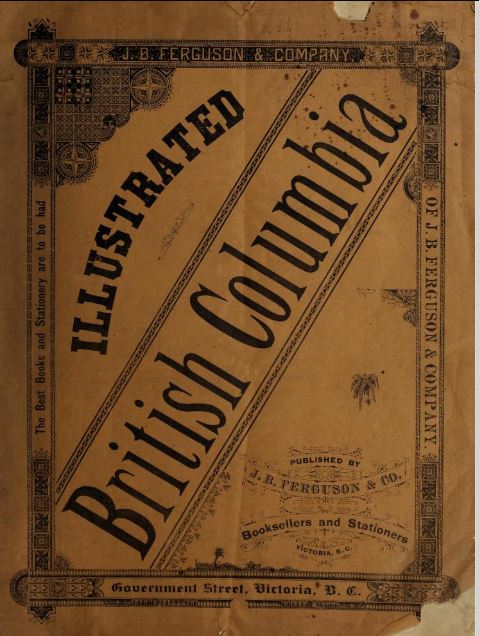
Located at 325 Government, three doors south of the post office, J.B. Ferguson & Co. opened on May 31, 1884, with an initial stock of books, stationery, and fancy goods valued at $18,000 (3). Later that same year, Ferguson raised his market profile by publishing Illustrated British Columbia, a book of lithographic prints of Victoria.
In May 1886, Ferguson took a huge competitive step in the BC bookselling scene when he partnered with Thomas Robson Pearson, David Robson, and J.A. Hart in forming the British Columbia Stationery and Printing Company. The new company absorbed Ferguson’s Victoria concern as well as T.R. Pearson & Co. in New Westminster and Vancouver.
“All the gentlemen are practical stationers and full of energy, and we predict for the new organization a bright and very prosperous future,” declared the Daily Colonist (4).
A series of setbacks, however, would challenge this prediction and ultimately prompt Ferguson to move back to Winnipeg. I’ll pick up from there next time.
Notes
(1) Memorable Manitobans: John Bowerman Ferguson.
(2) “The Brunswick Leased,” Daily Colonist (March 28, 1884).
(3) Books and Notions (December 1884): 78.
(4) “The B.C. Stationery and Printing Company,” Daily Colonist (May 22, 1886): 3.
***

