Bookselling History

The Stationarii

Since starting my research about early BC booksellers, I’ve been curious about why they were so often called stationers.

True, most bookstores of the nineteenth and early twentieth centuries sold stationery products in addition to books (as they do today). But it turns out that their proprietors’ common title of “stationer” had a lot more to do with the historical origins of bookselling than with their inventory.

“In the Middle Ages, booksellers in Rome were called stationarii.”

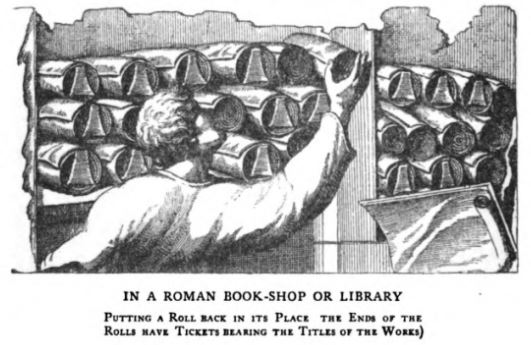
In the Middle Ages, booksellers in Rome were called stationarii, “either from the practice of stationing themselves at booths or stalls in the streets (in contradistinction to the itinerant vendors) or from the other meaning of the Latin term statio, [meaning] entrepôt or depository…The term stationer soon became synonymous with bookseller.” (1)
Illustration from Frank A. Mumby, The Romance of Bookselling, p. 12.

It is easy to romanticize these stationarii at their stalls, disseminating learning and ideas to a literate Roman public. However, the Middle Ages book trade evolved from a less-than-wonderful method of making books that were both plentiful and cheap.

Centuries earlier, in the time of the emperor Augustus (d. AD 14), “every respectable house possessed a library, and among the better classes, the slave-readers (anagnostœ) and the slave-transcribers (librarii) were almost as indispensable as cooks and scullions.” (2)

Initially, “these slaves were employed in making copies of celebrated books for their masters; but gradually the natural division of labour produced a separate class of publishers.”

The first of these was a man named Atticus, who “saw an opening for his energies in the production of copies of favourite authors upon a large scale. He employed a number of slaves to copy from dictation simultaneously, and was thus able to multiply books as quickly as they were demanded.”

By the time of the stationarii in about the thirteenth century, monks and university-trained copyists had largely replaced slaves as the main source of transcription labour. And two centuries later, the printing press would, when it came to book reproduction, displace the human hand for good.

Notes

(1) Henry Curwen, A History of Booksellers, the Old and the New (London: Chatto and Windus, 1873), 13-14.

(2) This and the next two quotes are from Curwen, 10-11.
New Westminster

Carrying and Passing the Bookstore Torch: Henry Morey, Part 3

After a few diversions to show how 19th-century bookstores took part in the festive holiday season, I’ll now pick up the story of Henry Morey in New Westminster.

Following the fire that burned out his store on Columbia Street in 1891, Henry Morey steadily rebuilt his book and stationery business. In 1895, he expanded into job printing when he bought out printer Frank Noot (1), and a year later, the firm moved to the Armstrong-Young block at 705 Columbia (2).

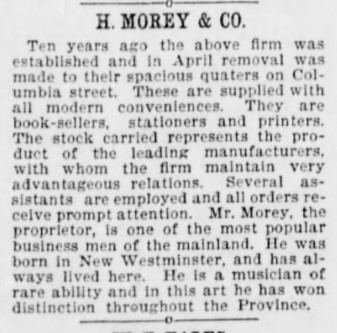
(Vancouver Daily World, June 20, 1896, p. 48)

Over the next ten years, Morey & Co. ads hint at multiple disruptions, with the firm moving at least half a dozen times. Nevertheless, the company seemed to prosper. A glowing article in the Daily News in 1910 called Morey & Co. “without doubt today the most up-to-date in the Royal City…Here are to be found the requirements of the school child, the parent, the business and professional man, the student or the divine.”

“But the firm of Morey & Co. do not only look after the serious side of life for their large clientele,” the article continued; “pleasure also enters into their stock, as is shown by the large stock of toys and sporting goods they handle” (3).

“But the firm of Morey & Co. do not only look after the serious side of life for their large clientele; pleasure also enters into their stock.”

“A great deal of the credit for the continued growth and expansion of the concern is due to its founder…who has through the years steadily adhered to high standards of business integrity, has given largely of his time and energies to the expansion of the enterprise, has studied modern merchandising and has applied his knowledge in a practical and constructive way,” praised the editors of a 1914 biographical dictionary (4).

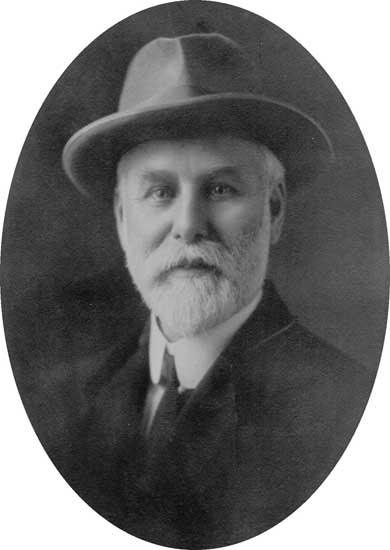
Henry Morey, ca. 1910s (New Westminster Archives, IHP2492).

In 1924, Morey sold his business to Alan and David Nixon (5). In retirement, Morey built a “splendid home and developed an outstanding garden” in South Westminster (6). He died, unexpectedly, at the age of seventy-four in 1936, and is buried in Fraser Cemetery.

As for the business he had founded in 1886, it continued on as Nixon’s Book Store—first under the Nixon family’s management and then under new owners Bob Hall and Ernie Ramsey—until closing in 1994 (7).

Notes

(1) American Stationer (October 17, 1895): 722.

(2) Vancouver Daily World (April 21, 1896): 5.

(3) “H. Morey & CO.,” Daily News (October 4, 1910): 20.

(4) British Columbia from the Earliest Times to the Present: Biographical vol. IV (Vancouver, Portland, San Francisco, Chicago: S.J. Clarke Publishing Company, 1914), 504.

(5) Henry Morey obituary, Vancouver Sun (May 16, 1936): 1.

(6) Ibid.

(7) “Closing the Book,” Royal City Record/Now (June 29, 19940: 11.