Picking up from my last post about the fantastic photo of Vancouver’s Clarke & Stuart, here’s one that takes us inside a 19th-century bookstore: T.N. Hibben & Co. of Victoria.
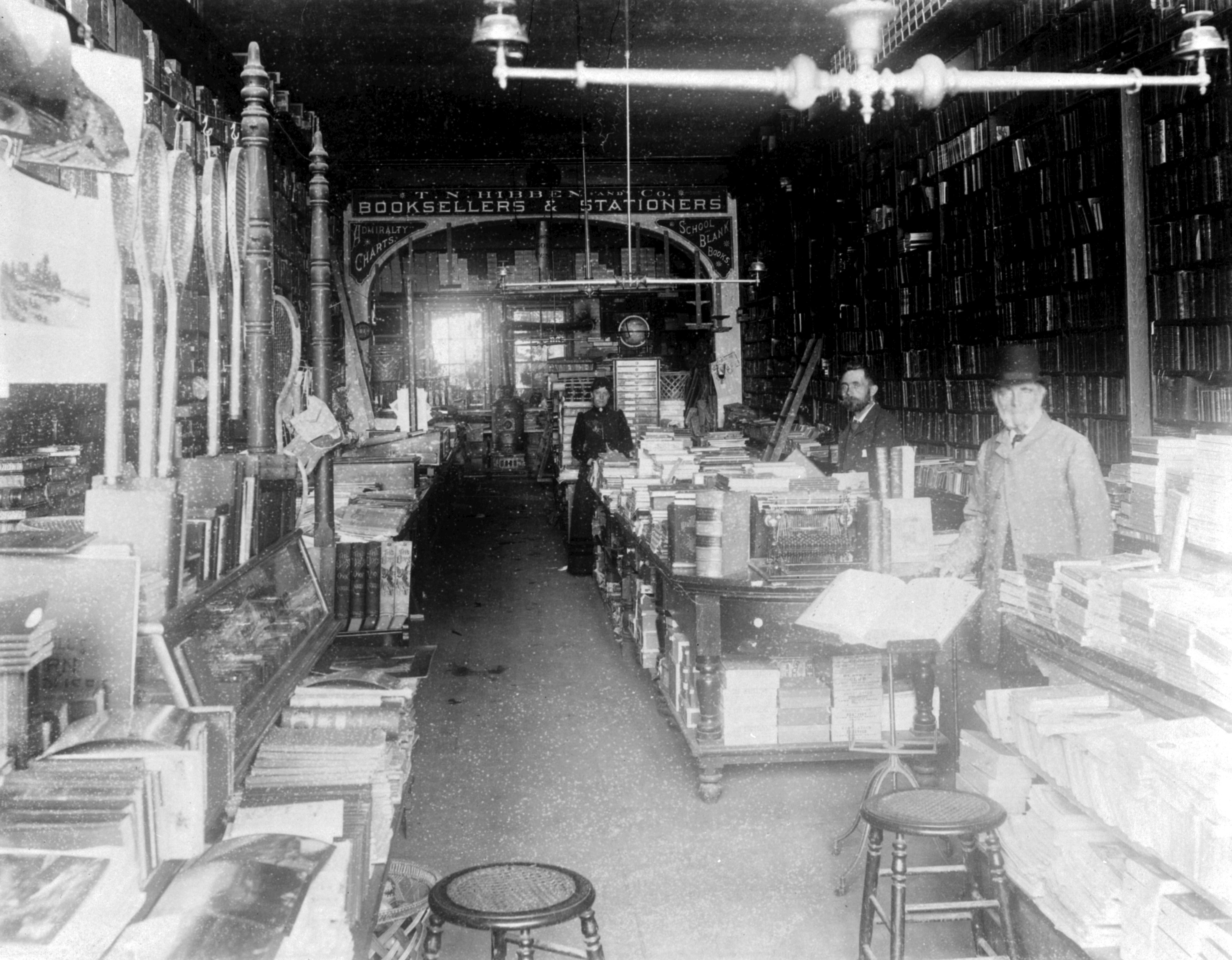
The interior of T.N. Hibben & Co., Victoria (Royal BC Museum and Archives, G-02974).
Here we can see all the wonderful books lining the walls (floor to ceiling, at least on the right) and displayed down the middle. I feel like I can almost smell their leather bindings.
Stationery and blank books, some of which we can see at the front right, were important parts of the business, as were items like photographs, maps, typewriters and office equipment, toys, and sporting goods, like the racquets hanging on the left.
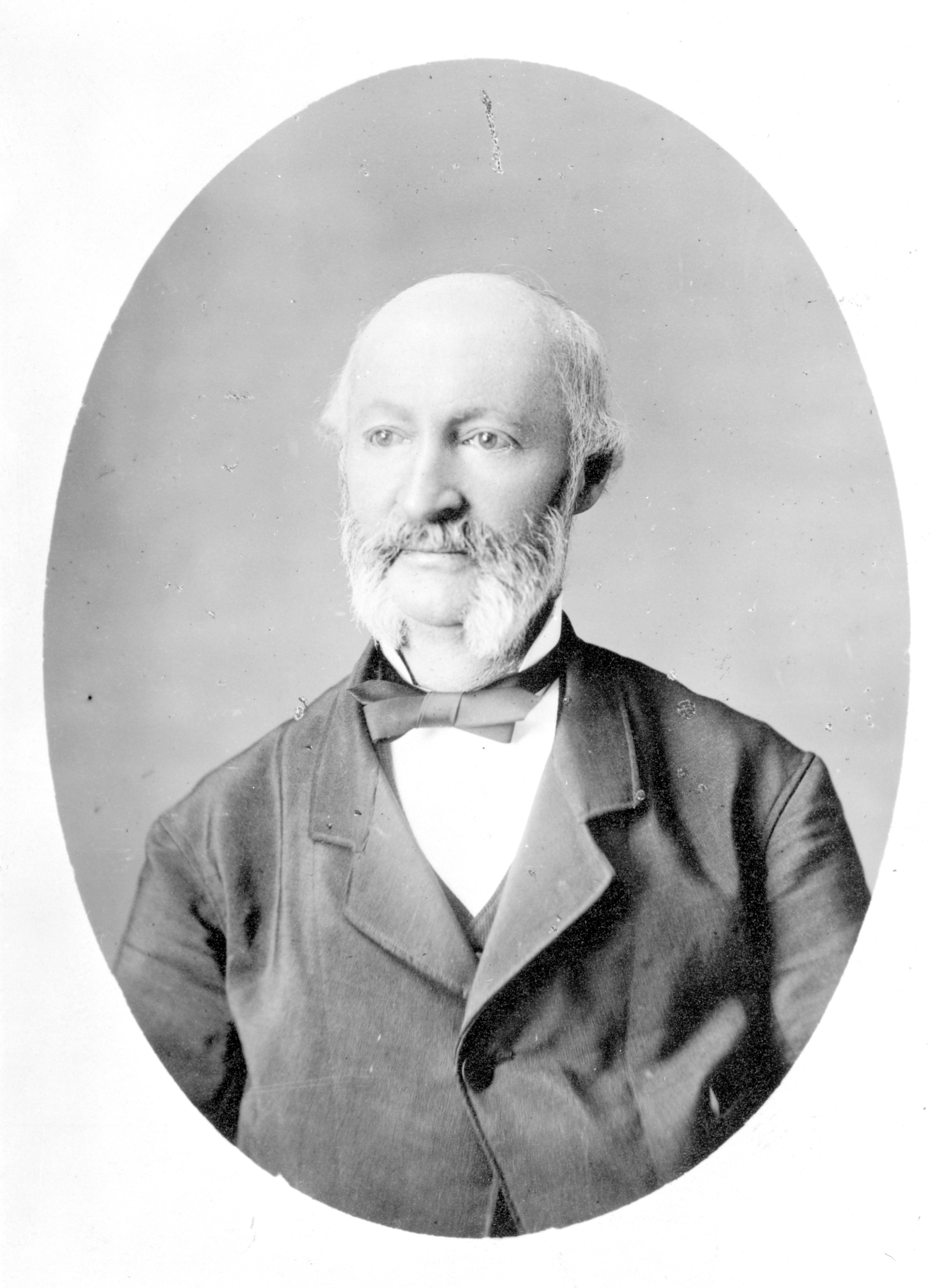
Although the Royal BC Museum and Archives dates this photo as ca. 1891, I believe it was taken before January 1890, because that is when founder Thomas Napier Hibben died, and the man on the front right looks an awful lot like Hibben in the portrait below, with his distinctive white beard either side of an exposed chin.
Thomas Napier Hibben, ca. 1860 (Royal BC Museum and Archives, F-02887).
In 1894, when Vancouver’s first bookseller, Seth Thorne Tilley, exited the bookselling business, he handed the baton to Harold Clarke and James Duff-Stuart.
The two were former clerks with Thomson Bros., one of Tilley’s main rivals in Vancouver. After purchasing the business, they renamed it Clarke & Stuart.
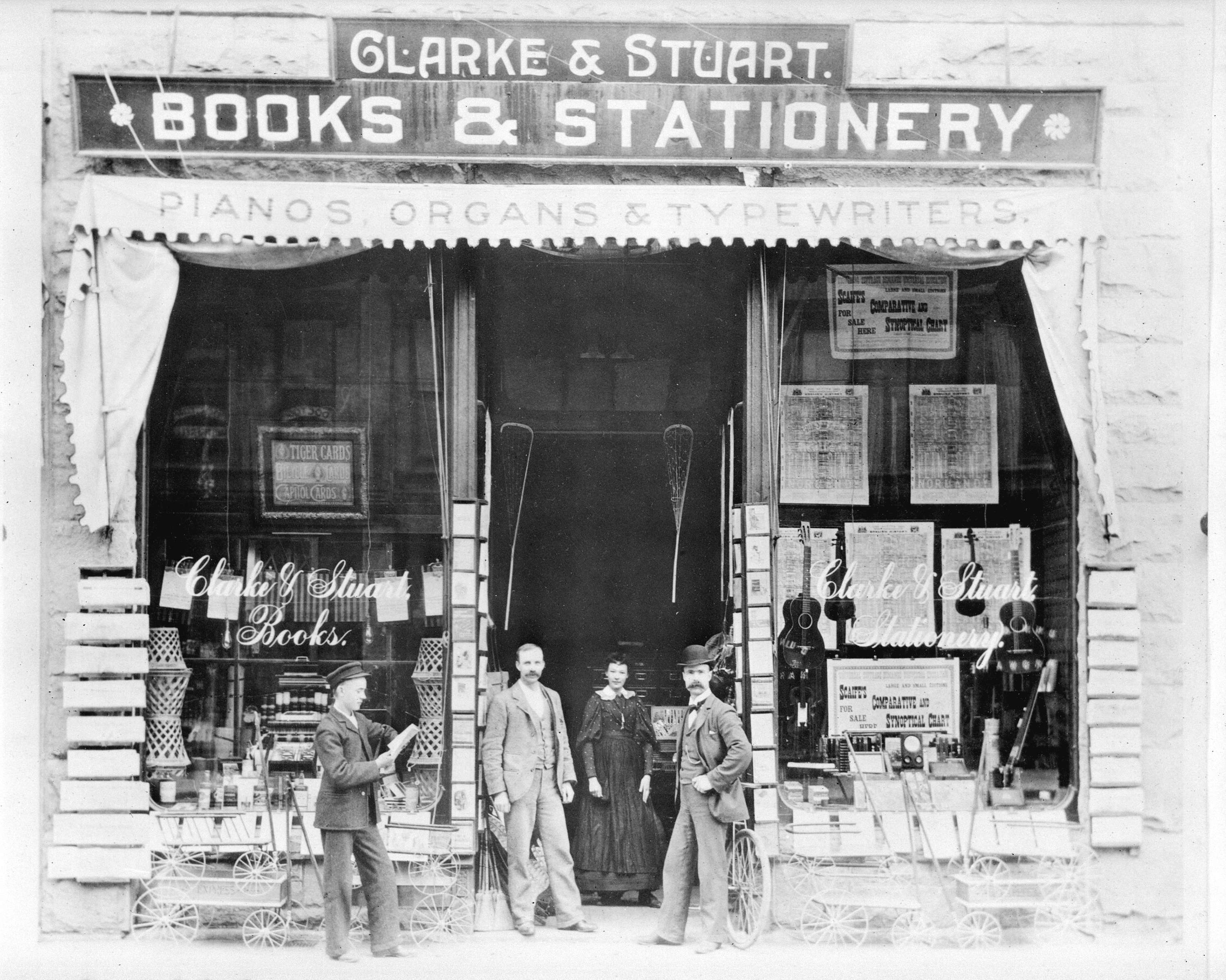
Initially they remained in Tilley’s location at 11 Cordova, but by 1896, they had moved to a new store across the street, at 28 Cordova, and that is where this photo was taken.
Clarke & Stuart’s store at 28 Cordova Street, Vancouver, c. 1898. Harold Clarke is at right and James Duff-Stuart is at left in the doorway (Vancouver Archives, AM54-54-: Bu N283.1).
Viewed at full size, the photo reveals so much detail, giving us more than just a fuzzy glimpse into booksellers and stationers of the past.
In the window at the right hang newspaper broadsheets and posters promoting Scaife’s Comparative and Synoptical Chart, the 19th-century version of an infographic. We can also see guitars and violins in that window, and wagons, a bicycle, and brooms out front.
In the left window we can see a sign advertising Tiger cards, Bicycle cards, and Capitol cards, and a string of what look like clipboards, perhaps notices of community goings-on. And are those baskets of some kind? And lightbulbs! And a row of leather-bound books lined up inside.
On each side of the door are what appear to be stands with books or greeting cards, and above the entrance hang lacrosse rackets. Inside, we can just make out a bank of filing cabinets. A banner above the door proclaims that pianos, organs, and typewriters can also be had here, along with, of course, books and stationery.
The faces of the two men—whom I believe to be Duff-Stuart (left) and Clarke (right)—and the woman, presumably a clerk, standing in the entrance are alert and intelligent, the woman’s expression especially welcoming. And the boy—a messenger or delivery boy?—at left looks like just the sort of chap to get things done quickly and well.
Don’t you wish you could step inside and buy a book?
I was recently contacted by someone who is writing a biography of Robert Carswell, founder of the legal-publishing firm Carswell Company in Toronto in the mid-1860s. She wondered, just as I once did, if there was any connection between her subject and my Victoria bookseller James Carswell, a partner in Hibben & Carswell from 1858 to 1866.
Both of us had come across claims, like one here, that after dissolving his partnership with Hibben, James had moved to Toronto to co-found the legal-publishing firm. However, based on newspaper articles from the time and various archival records I’ve collected, I have concluded that this is not true.
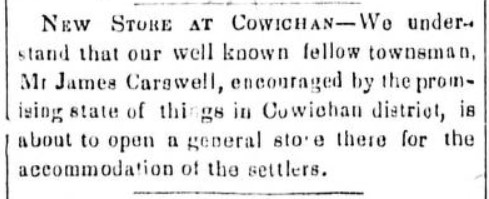
In 1867, just a few months after leaving Hibben, James was reported to have opened a general store in Cowichan:
(Daily Colonist, May 24, 1867)
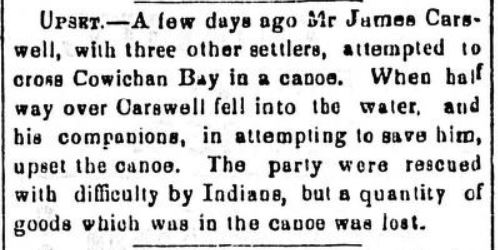
James was still in Cowichan in March 1868, when he made the news for capsizing his canoe in Cowichan Bay:
By 1871, James had quit BC for Glasgow, where his wife, Elizabeth Ferguson (and likely he himself), was from. In a letter published in the Colonist, Reverend Thomas Somerville (a minister from Glasgow who had been with the Presbyterian church in Victoria) reported that James had set up an agency business there.
On October 19, 1872, James died in Glasgow. Although the local BC newspapers reported (with the same Rev. Somerville as the source) that James had “cut his hand severely and bled so freely that he never recovered,” his Scottish death certificate records the cause as epilepsy. It also states that he was 47 years old and a restaurateur at the time of his death.
Although it seems highly unlikely that James could have fit in the co-founding of Carswell Company in Toronto, I thought there might still be a familial connection between the two bookish Carswells. However, finding any evidence of this has also proved elusive.
We know from James’s marriage and death certificates that his parents were John and Anne (Finnie) Carswell, and that he was born in about 1825, whereas Robert was born in Colborne, Ontario, in 1838, to Hugh and Margaret Carswell, both originally from Glasgow.
So they weren’t brothers. But perhaps cousins or uncle/nephew?
Maddeningly, I haven’t been able to find a birth record for James Carswell in Scottish archives. However, John Carswell and Anne Finnie are recorded as having multiple children, including a son named Hugh in February 1825. Huh. James Carswell was 47 in October 1872, so I concluded that his birth year was 1825. Were James and Hugh twins? One and the same person? Or was James’s age perhaps recorded incorrectly at his death?
I still don’t know, but even so, this Hugh Carswell would have been too young to have fathered Robert Carswell in Colborne in 1838. And there the mystery still remains…