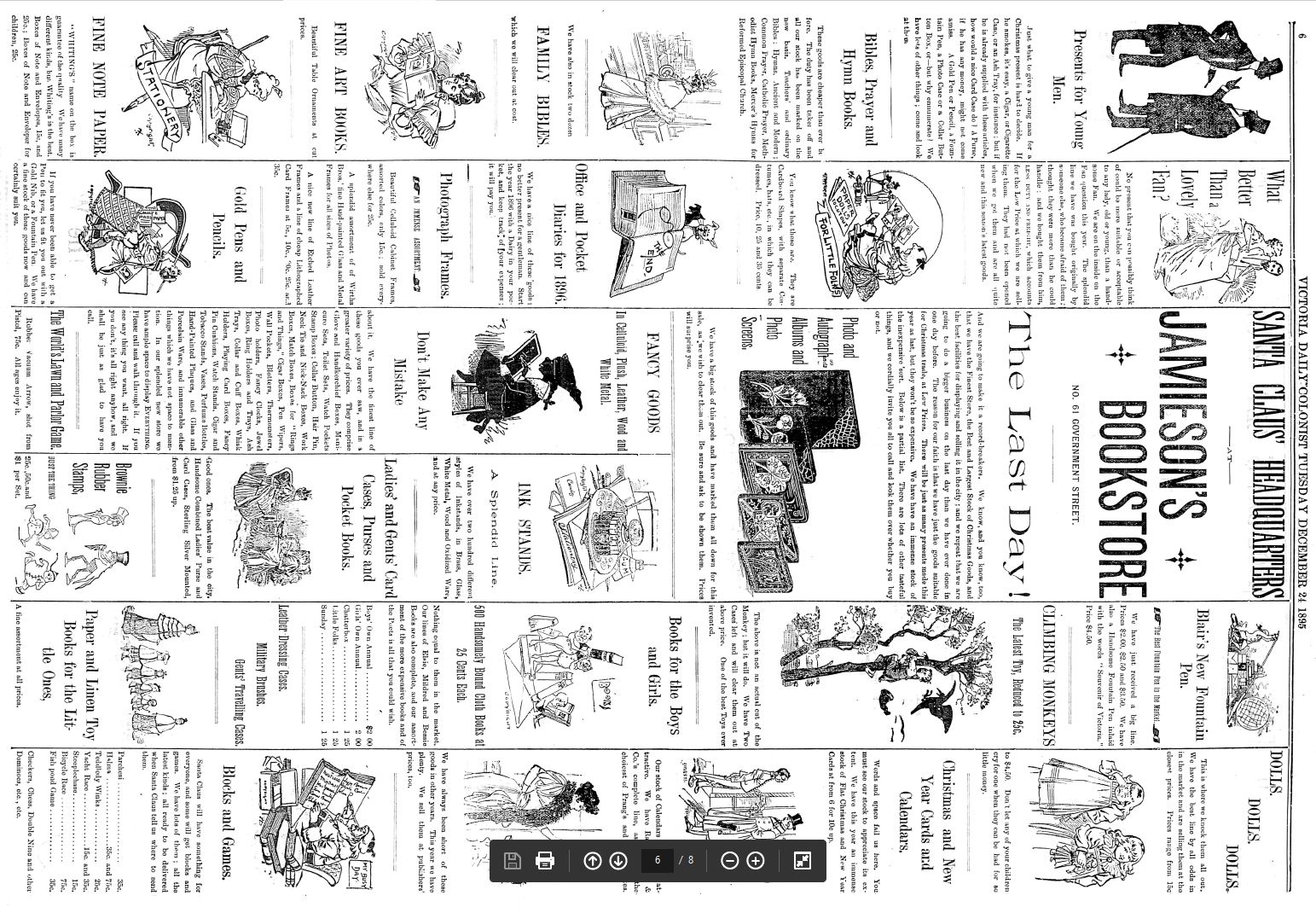
This splendid full-page ad is from Robert Jamieson’s bookstore in Victoria, 1895. (Click to enlarge.)
History of Booksellers and Stationers in British Columbia
This splendid full-page ad is from Robert Jamieson’s bookstore in Victoria, 1895. (Click to enlarge.)
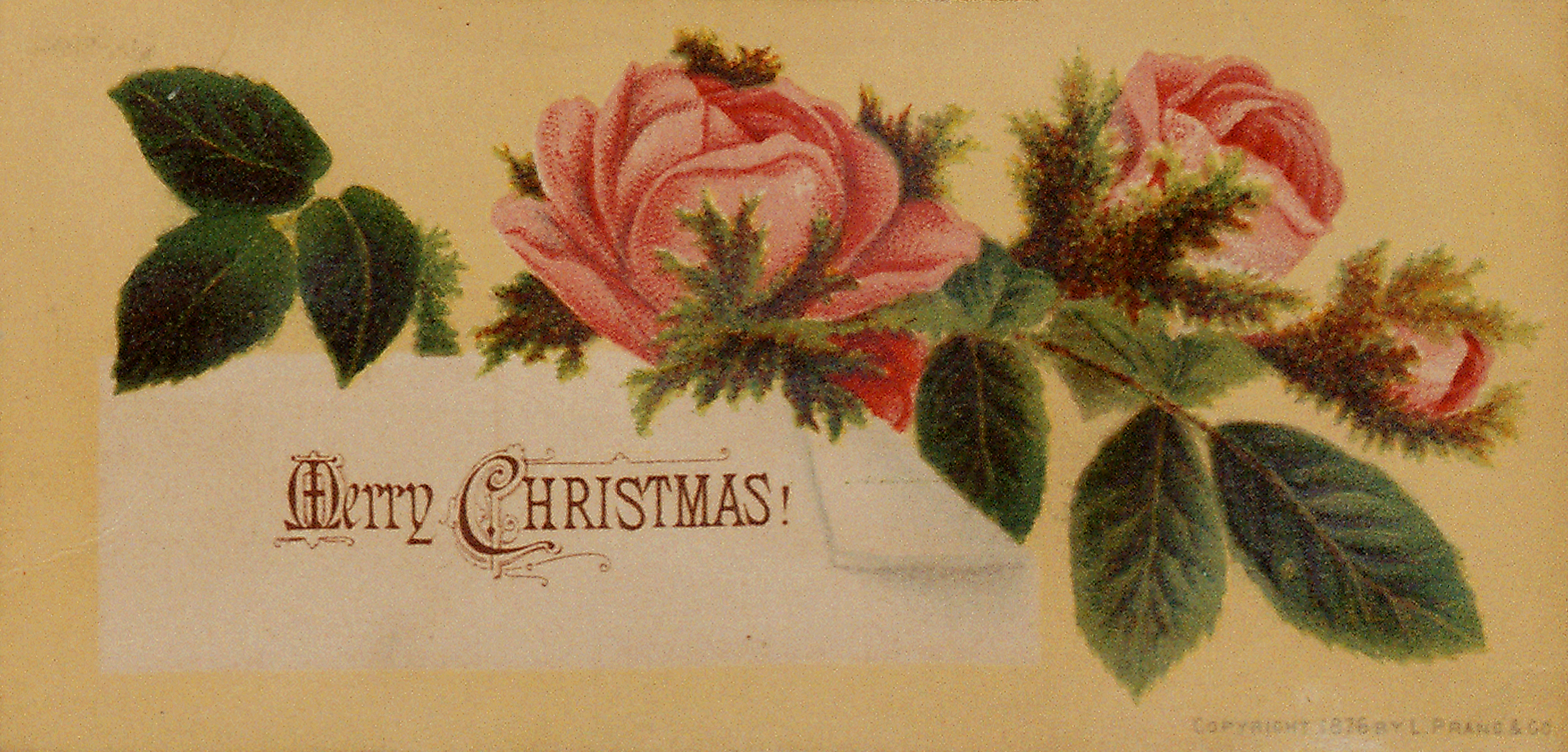
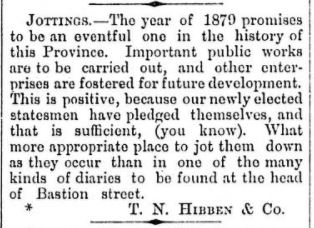
In Book of Small, her memoir about her childhood in Victoria, Emily Carr recalls the red cardboard sign that Thomas Napier Hibben hung in his bookstore’s window each December, its “Merry Christmas” message written with cotton wool.
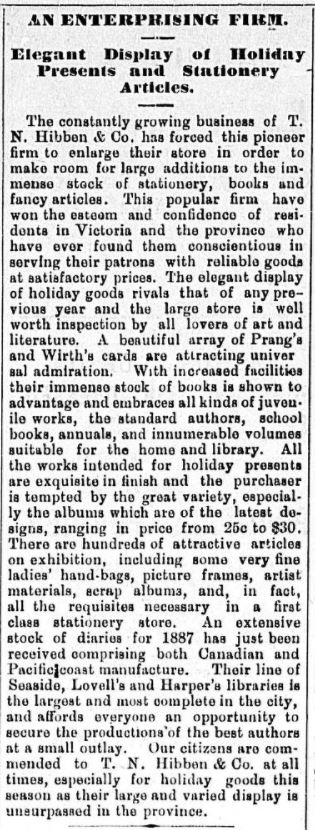
In nineteenth-century Victoria (as now, judging by the lineup at my local bookstore the other day), Christmas shoppers flocked to bookstores for gifts. In addition to books, they were drawn to all the fancy goods and “requisites necessary in a first class stationery store,” as the following article describes:
Among the attractions were a fairly new item at the time: Christmas cards. The Prang cards mentioned above were those of Louis Prang, the Boston-based printer who is credited as the father of the American Christmas card when he became the first American publisher of Christmas cards in 1875.
Diaries for the upcoming year were another popular, heavily advertised Christmas gift item. Selections numbered in the dozens, with many bound in fine leather, edged in gilt, sized for a pocket, and complete with additional compartments for bills and calling cards.
(Feature image for this blog post on the home page is from http://blog.nyhistory.org/prang/, Christmas card, L. Prang and Co., 1876. PR 31, Bella C. Landauer Collection)
New Westminster’s Henry Morey was in his fifth year of business as a bookseller and stationer when disaster struck on February 15, 1891 (1).
At 5 a.m., live coals in an ash box suddenly flamed up in the rear room of watchmakers and jewellers Stirsky & Son at 715 Columbia Street. A patrolling police constable soon noticed the smoke billowing from Stirsky’s store, but no water was readily available to snuff out the fire.
Finding ample fuel in the wooden buildings housing Stirsky’s and adjacent stores, the fire soon consumed the west half of the block. Within the hour, eight stores, including Morey’s at 713 Columbia, were levelled to the ground.
“Within the hour, eight stores, including Morey’s at 713 Columbia, were levelled to the ground.”
The fire also started spreading in the other direction along Columbia toward the real estate office of T.J. Trapp at the corner with Lorne Street. Adjacent to Trapp’s store was the grand Masonic and Oddfellows block fronting on Lorne, said to be one of the finest buildings in the province.
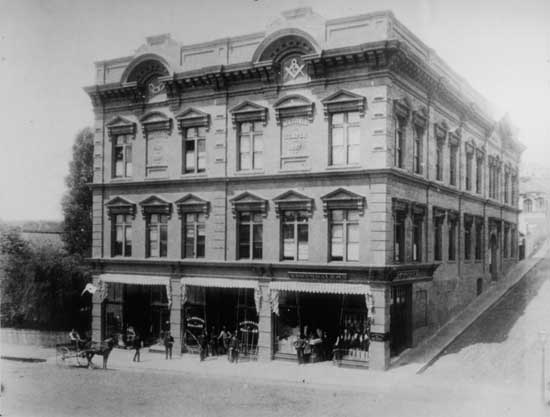
At 6:30 a.m., “a terrific explosion occurred caused by powder stored in the cellar of Trapp’s store. This explosion smashed all the windows in the neighborhood and shook up the Masonic block so badly that the fire got a new hold despite the hard work of the firemen. This magnificent building was soon ablaze inside and was completely gutted, together with its contents” (2).
At 11:00 a.m., part of the north wall of the Masonic block caved in. Falling bricks hit a passing hack driver, Fred McKinnon, breaking both of his legs and one arm. Otherwise, no one else was seriously injured—which seems miraculous considering the explosives stored in Trapp’s cellar.
The property damage was significant, however. Losses were estimated at $175,000 to $200,000, with insurance covering about half of that. What had started out as live coals carelessly left in an ash box turned out to be “the largest and most destructive conflagration ever seen in Westminster” to that point. “Never in the history of Westminster did our principal thoroughfare look so completely demoralized and desolate,” reported the local newspaper (3).
“Never in the history of Westminster did our principal thoroughfare look so completely demoralized and desolate.”
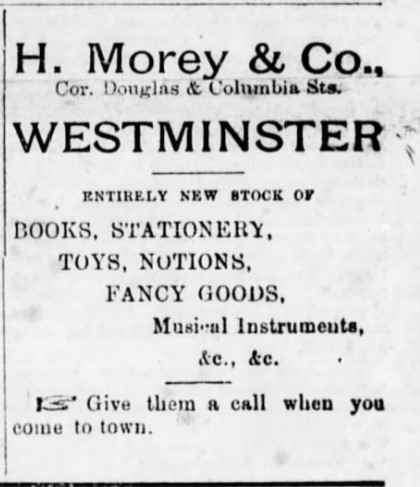
Morey suffered a total loss of his store and inventory, with insurance coverage of only $2,000. And yet, by April, he was up and running again, boasting in newspaper ads of new stock and new premises at the corner of Douglas and Columbia opposite the Central Hotel.
Notes
(1) The account of the fire in this post is drawn from the Manitoba Free Press (February 16, 1891): 1; and the Daily Colonist (February 17, 1891): 3.
(2) Manitoba Free Press (February 16, 1891): 1.
(3) Daily Colonist (February 17, 1891): 3.
***